This one weird GOP trick could stop US women from voting
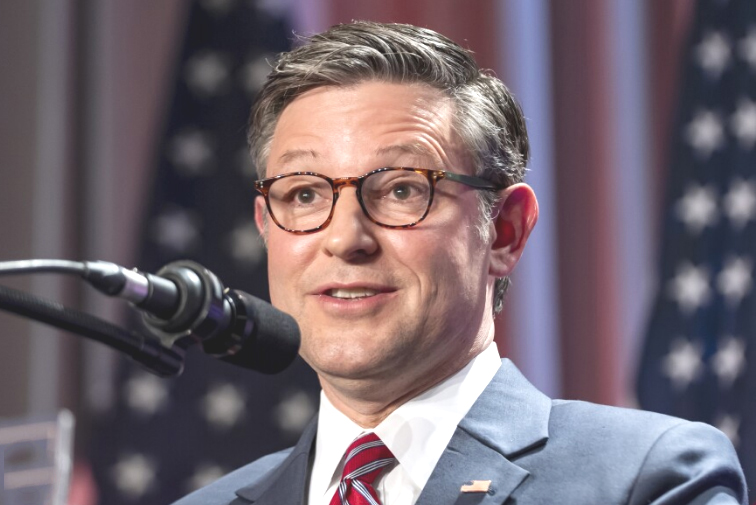
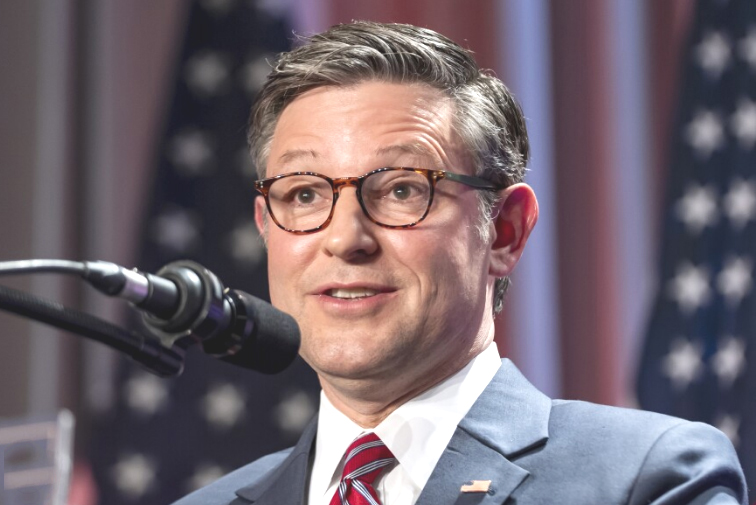
Grinder Mike and Republicans just can't stop hating women, so the GOP concocted The Save Act
ElectionFraud2026.Com
5/1/202610 min read

The Save Act – which would do the opposite of its title – could have a huge impact on the midterm elections
Beware the Save Act
Arwa Mahdawi - The Guardian
If you are anything like me, then you are currently pickling in your own cortisol.
As the US grows increasingly violent, increasingly cruel, every day brings a legion of new horrors.
So I’m very sorry to say that I’m here to ruin your weekend by giving you yet another thing to worry about.
That thing is called the Save Act and, if the Trump administration gets its way, it could have an oversized impact on the November midterms, particularly when it comes to minorities and married women being able to vote.
A good rule of thumb when looking at a Republican-drafted bill or campaign is that its name is directly the opposite of whatever it is meant to achieve.
If there is something about ‘protecting women’ in the title, for example, then it’s probably actually about controlling women or bullying transgender people.
The same is true of the Safeguard American Voter Eligibility (Save) Act, which would change the way US citizens register to vote.
The purpose of the bill doesn’t seem to be to safeguard democracy but to help destroy it through stealth disenfranchisement.
If it became law, the Save Act would require Americans to provide a birth certificate, passport, or other citizenship document to register or re-register to vote.
Per one Brennan Center Study, more that 21 million American citizens, many of whom are engaged voters, do not have easy access to these documents.
While just over 8% of self-identified white American citizens don’t have these documents readily available, the Brennan Center found the number is nearly 11% among Americans of color.
Women who changed their name when they got married may also face a logistical nightmare: reports show that as many as 69 million women who have taken their spouse’s name don’t have a birth certificate that matches their legal name.
“The legislation does not mention the potential option for these Americans to present change-of-name documentation or a marriage certificate in combination with a birth certificate to prove their citizenship,” the liberal thinktank the Center for American Progress noted.
To make things even more complicated for everyone, the Save Act would also disrupt online voter registration.
Americans would have to appear in person, with their original documents, simply to update their voter registration information.
A proof-of-citizenship law similar to the Save Act has been tried before, by the way, including between 2013 and 2017 in Kansas.
And guess what? It was an expensive disaster that prevented more than 30,000 Kansans from voting.
It’s well-established that these sorts of laws disproportionately harm low-income, disabled, married women, and marginalized voters.
Why are the Republicans so keen on making it harder for these groups to vote?
I’m sure I don’t need to spell it out for you.
Of course the Save Act isn’t being presented as a way for Republicans to sneakily sway the midterms in their favour as confidence in Trump dips.
Rather, it’s being presented as a way to stop fraudulent voting.
“[W]e all know, intuitively, that a lot of illegals are voting in federal elections,” house speaker Mike Johnson said during a press conference about the act when it was first introduced in May 2024.
“But it’s not been something that is easily provable.”
I think we all know, intuitively, that it’s not easily provable because that claim is nonsense.
And, in fact, we don’t need to rely on intuition, we have data!
One Brennan Center for Justice study that looked at the 2016 election found just 0.0001% of votes (30 incidents) across 42 jurisdictions, with a total of 23.5m votes, were suspected to include non-citizens voting.
Non-citizens voting is already illegal and not a problem that needs to be solved with new legislation.
So just how likely is it that the Save Act, or some version of it, will get passed before the midterms?
Unclear, but looking increasingly likely by the day, unfortunately.
The Save Act passed in the House in 2025 but then stalled in the Senate.
Now, however, there’s a lot of new momentum to try and get it over the line.
In a speech to House Republicans at the beginning of the year, Trump urged lawmakers to pass a national voter ID law ahead of the 2026 midterm election and his cronies have ramped up their efforts to draft what House majority leader Steve Scalise recently called an “even stronger” version of the Save Act.
And, of course, if it’s not the Save Act it’ll be something else.
The Trump administration has been busy chipping away at the mechanisms that keep election systems free and fair.
They can’t (yet) get away with cancelling the November midterms but they can destroy faith in the system through baseless claims of voter fraud.
They can redraw congressional maps and try to impose onerous voting requirements.
This, of course, is how democracy dies. Not in darkness, but in daily headlines.
Not with a bang, but with a relentless barrage of paperwork.
Not with one power-hungry man breaking the law, but with his legion of acolytes weaponizing it.
ELECTIONFRAUD2026.COM: Republicans thought long and hard about a new way to prevent women and poor people from voting; so the GOP came up with "The Save Act"
The Save Act – which would do the opposite of its title – would require voters to produce a birth certificate that matches their name on state voter rolls; something that could disqualify as many as 69 million women from voting.
What is the GOP genesis of "The Save Act?"
The GOP genesis of "The Save Act" began in Wisconsin in 2006, prior to the 2006 midterms when Republicans knew they would most likely lose the 2006 midterms, so they paid for a study to determine how many voters could be disenfranchised if a red state passed an unconstitutional state law requiring a STATE ID in order to cast a vote.
Republicans found out that Republicans could eliminate 5-20% of the vote by passing a state VOTER ID law; and those 5-20% would most likely be poor people who traditionally vote Democrat all their lives.
That's why red state Republican officials raised the rates for purchasing and obtaining a certified birth certificate - as much as $120 per certified copy.
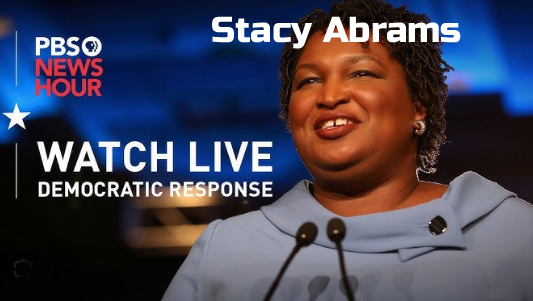
Republican propaganda has been so successful that even Dumbo Democrats like Georgia belle Stacy Abrams vigorously support GOP VOTER ID laws.
Apparently Abrams never spent a moment or two contemplating the FACT that prior to 2006, no voter in U.S. history was required to produce a state-issued ID card to cast a vote.
This bears worth repeating: since 1776 no American voter was required to show a state ID card in order to vote - UNTIL 2006 AND WISCONSIN REPUBLICANS.
Why not? Because courts have long ruled that any such state ID requirement would be a POLL TAX, and poll taxes are patently unconstitutional for over 200 years.

GOP History of Legislative Madness re: Voting in America
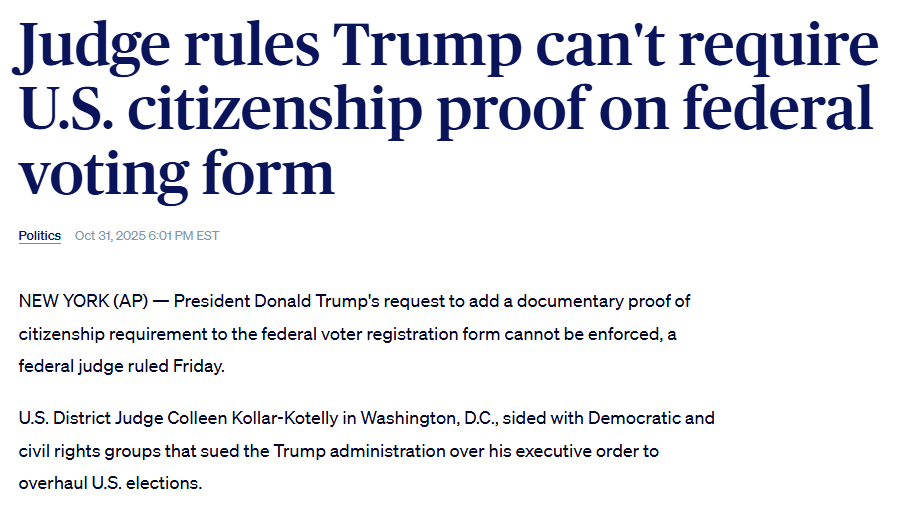
October 31, 2025
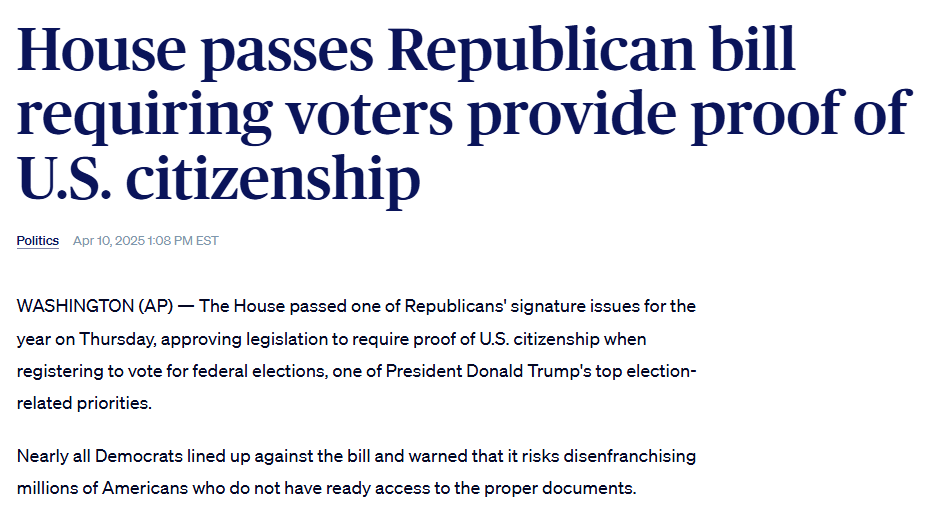
April 10, 2025


NEW YORK (AP) — President Donald Trump's request to add a documentary proof of citizenship requirement to the federal voter registration form cannot be enforced, a federal judge ruled Friday.
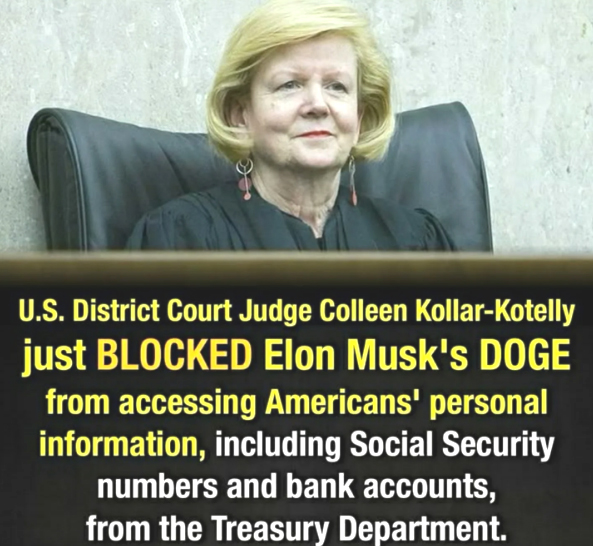
U.S. District Judge Colleen Kollar-Kotelly in Washington, D.C., sided with Democratic and civil rights groups that sued the Trump administration over his executive order to overhaul U.S. elections.
READ MORE: Maine and Texas latest fronts in voting battles, with voter ID, citizenship on the ballot
She ruled that the proof-of-citizenship directive is an unconstitutional violation of the separation of powers, dealing a blow to the administration and its allies who have argued that such a mandate is necessary to restore public confidence that only Americans are voting in U.S. elections.
"Because our Constitution assigns responsibility for election regulation to the States and to Congress, this Court holds that the President lacks the authority to direct such changes," Kollar-Kotelly wrote in her opinion.
She further emphasized that on matters related to setting qualifications for voting and regulating federal election procedures "the Constitution assigns no direct role to the President in either domain."
Kollar-Kotelly echoed comments she made when she granted a preliminary injunction over the issue.
The ruling grants the plaintiffs a partial summary judgment that prohibits the proof-of-citizenship requirement from going into effect.
It says the U.S. Election Assistance Commission, which has been considering adding the requirement to the federal voter form, is permanently barred from taking action to do so.
In a statement, Sophia Lin Lakin of the ACLU, one of the plaintiffs in the case, called the ruling "a clear victory for our democracy. President Trump's attempt to impose a documentary proof of citizenship requirement on the federal voter registration form is an unconstitutional power grab."
A message seeking comment from the White House was not immediately returned.
While a top priority for Republicans, attempts to implement documentary proof-of-citizenship requirements for voting have been fraught.
The U.S. House passed a citizenship mandate last spring that has stalled in the Senate, and several attempts to pass similar legislation in the states have proved equally difficult.
Such requirements have created problems and confusion for voters when they have taken effect at the state level.
It presents particular hurdles for married women who have changed their name, since they might need to show birth certificates and marriage certificates as well as state IDs.
Those complications arose earlier this year when a proof-of-citizenship requirement took effect for the first time during local elections in New Hampshire.
In Kansas, a proof-of-citizenship requirement that was in effect for three years created chaos before it was overturned in federal court.
Some 30,000 otherwise eligible people were prevented from registering to vote.
Voting by noncitizens also has been shown to be rare.
The lawsuit brought by the DNC and various civil rights groups will continue to play out to allow the judge to consider other challenges to Trump's order.
That includes a requirement that all mailed ballots be received, rather than just postmarked, by Election Day.
Other lawsuits against Trump's election executive order are ongoing.
In early April, 19 Democratic state attorneys general asked a separate federal court to reject Trump's executive order.
Washington and Oregon, where virtually all voting is done with mailed ballots, followed with their own lawsuit against the order.
Riccardi reported from Denver.
January 29, 2026
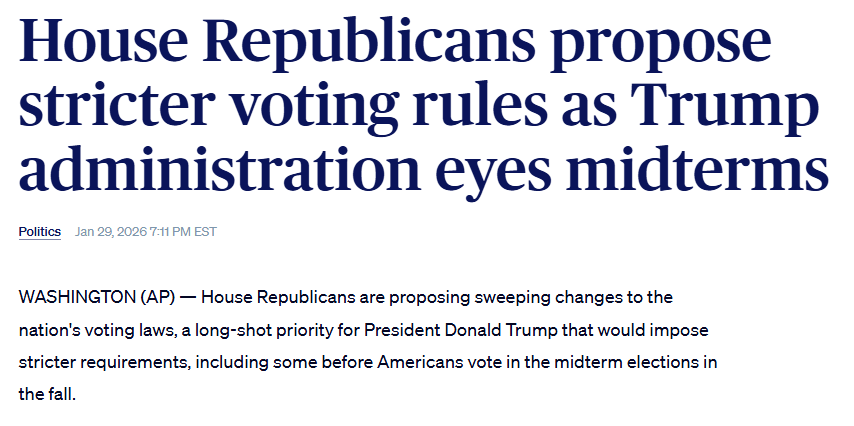
WASHINGTON (AP) — House Republicans are proposing sweeping changes to the nation's voting laws, a long-shot priority for President Donald Trump that would impose stricter requirements, including some before Americans vote in the midterm elections in the fall.
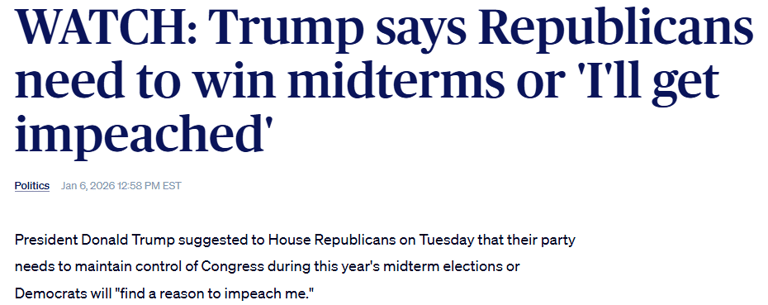
WATCH: Trump says Republicans need to win midterms or 'I'll get impeached'
The package released Thursday reflects a number of the party's most sought-after election changes, including requirements for photo IDs before people can vote and proof of citizenship, both to be put in place in 2027.
Others, including prohibitions on universal vote-by-mail and ranked choice voting — two voting methods that have proved popular in some states — would happen immediately.
The Republican president continues to insist that the 2020 election he lost to Democrat Joe Biden was rigged.
"Americans should be confident their elections are being run with integrity — including commonsense voter ID requirements, clean voter rolls, and citizenship verification," said Rep. Bryan Steil, chairman of the House Administration Committee, in a statement.
"These reforms will improve voter confidence, bolster election integrity, and make it easy to vote, but hard to cheat," said Steil, R-Wis.
The legislation faces a long road in the narrowly-split Congress, where Democrats have rejected similar ideas as disenfranchising Americans' ability to vote with onerous registration and ID requirements.
The effort comes as the Trump administration is turning its attention toward election issues before the November election, when control of Congress will be at stake.
The administration sent FBI agents Wednesday to raid the election headquarters of Fulton County, Georgia, which includes most of Atlanta, seeking ballots from the 2020 election.
That follows Trump's comments earlier this month when he suggested that charges related to that election were imminent.
READ MORE: Top Democrats on intelligence committees question Gabbard's presence at election office raid
Republicans are calling their new legislation the "Make Elections Great Again Act" and say their proposal should provide the minimum standard for elections for federal offices.
The 120-plus-page bill includes requirements that people present a photo ID before they vote and that states verify the citizenship of individuals when they register to vote, starting next year.
More immediately, this fall it would require states to use "auditable" paper ballots in elections, which most already do; prohibit states from mailing ballots to all voters through universal vote-by-mail systems; and ban ranked choice voting, which is used in Maine and Alaska.
States risk losing federal election funds at various junctures for noncompliance. For example, states would be required to have agreements with the attorney general's office to share information about potential voter fraud or risk losing federal election funds in 2026.
And starting this year, it would require states to more frequently update their voting rolls, every 30 days.
Similar proposals have drawn alarm from voting rights group, which say such changes could lead to widespread problems for voters.
For example, prior Republican efforts to require proof of citizenship to vote have been criticized by Democrats as disenfranchising married women whose last names do not match birth certificates or other government documents.
The Brennan Center for Justice and other groups estimated in a 2023 report that 9% of U.S. citizens of voting age, or 21.3 million people, do not have proof of their citizenship readily available. Almost half of Americans do not have a U.S. passport.
Trump has long signaled a desire to change how elections are run in the United States. Last year he issued an executive order that included a citizenship requirement, among other election-related changes.
At the time, House Republicans approved legislation, the "Safeguard American Voter Eligibility Act," that would cement Trump's order into law.
That bill has stalled in the Senate, though lawmakers have recently revived efforts to bring it forward for consideration.
Associated Press writer Nicholas Riccardi in Denver contributed to this report.