GOP Voter Supression Techniques
Here's how they did it and will do it again
ElectionFraud2026.Com
1/31/202610 min read

It's time for voters to learn HOW the Republican Party and GOP operatives have been suppressing millions of votes, disenfranchising millions of voters.
The primary methods used involve wrongfully and systematically removing non-whites from state voter rolls, employing the use of provisional ballots and VOTER ID laws.
Removing Voters From State Voter Rolls
Greg Palast investigated and reported long ago, beginning in Bush V. Gore, how the GOP illegally removed voters by using state felon lists to cross-match names and remove same name voters from state voter rolls.


The Great Florida Ex-Con Game
by Greg Palast - March 1, 2002
In November the U.S. media, lost in patriotic reverie, dressed up the Florida recount as a victory for President Bush.
But however one reads the ballots, Bush’s win would certainly have been jeopardized had not some Floridians been barred from casting ballots at all.
Between May 1999 and Election Day 2000, two Florida secretaries of state – Sandra Mortham and Katherine Harris, both protegees of Governor Jeb Bush- ordered 57,700 “ex-felons,” who are prohibited from voting by state law, to be removed from voter rolls.
(In the thirty-five states where former felons can vote, roughly 90 percent vote Democratic.)
A portion of the list, which was compiled for Florida by DBT Online, can be seen for the first time here; DBT, a company now owned by ChoicePoint of Atlanta, was paid $4.3 million for its work, replacing a firm that charged $5,700 per year for the same service. If the hope was that DBT would enable Florida to exclude more voters, then the state appears to have spent its money wisely.
See the article with illustration in PDF
Two of these “scrub lists,” as officials called them, were distributed to counties in the months before the election with orders to remove the voters named.
Together the lists comprised nearly 1 percent of Florida's electorate and nearly 3 percent of its African-American voters.
Most of the voters (such as “David Butler,” (1); a name that appears 77 times in Florida phone books) were selected because their name, gender, birthdate and race matched – or nearly matched – one of the tens of millions of ex-felons in the United States.
Neither DBT nor the state conducted any further research to verify the matches.
DBT, which frequently is hired by the F.B.I. to conduct manhunts, originally proposed using address histories and financial records to confirm the names, but the state declined the cross-checks.
In Harris's elections office files, next to DBT's sophisticated verification plan, there is a hand-written note: DON’T NEED.
Thomas Alvin Cooper (2), twenty-eight, was flagged because of a crime for which he will be convicted in the year 2007.
According to Florida’s elections division, this intrepid time-traveler will cover his tracks by moving to Ohio, adding a middle name, and changing his race.
Harper’s found 325 names on the list with conviction dates in the future, a fact that did not escape Department of Elections workers, who, in June 2000 emails headed, “Future Conviction Dates,” termed the discovery, “bad news.”
Rather than release this whacky data to skeptical counties, Janet Mudrow, state liaison to DBT, suggested that “blanks would be preferable in these cases.” (Harper’s counted 4,917 blank conviction dates.)
The one county that checked each of the 694 names on its local list could verify only 34 as actual felony convicts.
Some counties defied Harris’ directives; Madison County’s elections supervisor Linda Howell refused the purge list after she found her own name on it.
Rev. Willie Dixon (3), seventy, was guilty of a crime in his youth; but one phone call would have told the state that it had already pardoned Dixon and restored his right to vote.
On behalf of Dixon and other excluded voters, the NAACP in January 2001 sued Florida and Harris, after finding that African-Americans”“who account for 13 percent of Florida’s electorate and 46 percent of U.S. felony convictions”
“were four times as likely as whites to be incorrectly singled out under the state’s methodology.
After the election, Harris and her elections chief Clay Roberts, testified under oath that verifying the lists was solely the work of county supervisors.
But the Florida-DBT contract (marked “Secret” and “Confidential”) holds DBT responsible for “manual verification using telephone calls.”
In fact, with the state’s blessing, DBT did not call a single felon.
When I asked Roberts about the contract during an interview for BBC television, Roberts ripped off his microphone, ran into his office, locked the door, and called in state troopers to remove us.
Johnny Jackson Jr. (4), thirty-two, has never been to Texas, and his mother swears he never had the middle name “Fitzgerald.”
Neither is there evidence that John Fitzgerald Jackson, felon of Texas, has ever left the Lone Star State.
But even if they were the same man, removing him from Florida's voter rolls is an unconstitutional act.
Texas is among the thirty five states where ex-felons are permitted to vote, and the “full faith and credit” clause of the U.S. Constitution forbids states to revoke any civil rights that a citizen has been granted by another state; in fact, the Florida Supreme Court had twice ordered the state not to do so, just nine months before the voter purge.
Nevertheless, at least 2,873 voters were wrongly removed, a purge authorized by a September 18, 2000 letter to counties from Governor Bush’s clemency office.
On February 23, 2001, days after the U.S. Commission of Civil Rights began investigating the matters, Bush’s office issued a new letter allowing these persons to vote; no copies of the earlier letter could be found in the clemency office or on its computers.
Wallace McDonald (5), sixty-four, lost his right to vote in 2000, though his sole run-in with the law was a misdemeanor in 1959.
(He fell asleep on a bus-stop bench.)
Of the “matches’ on these lists, the civil-rights commission estimated that at least 14 percent – or 8,000 voters, nearly 15 times Bush’s official margin of victory – were false.
DBT claims it warned officials “a significant number of people who were not a felon would be included on the list”; but the state, the company now says, “wanted there to be more names than were actually verified.”
Last May, Florida’s legislature barred Harris from using outside firms to build the purge list and ordered her to seek guidance from county elections officials.
In defiance, Harris has rebuffed the counties and hired another firm, just in time for Jeb Bush’s reelection fight this fall.
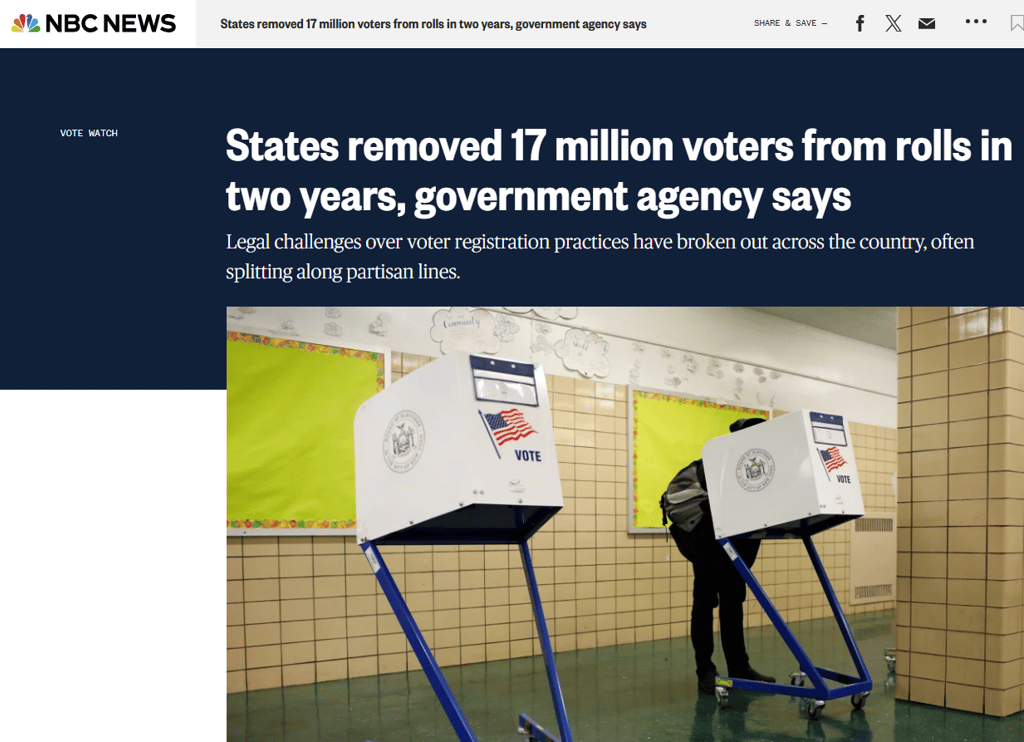
States removed 17 million voters from rolls in two years, government agency says
Legal challenges over voter registration practices have broken out across the country, often splitting along partisan lines.
NBC NEWS - June 27, 2019
States removed the registration records of more than 17 million voters between the 2016 and the 2018 elections in accordance with federal law, according to a report released Thursday by the U.S. Election Assistance Commission.


That number represents almost 17 percent more voters than were removed from 2012 to 2014 under the National Voting Rights Act, which mandates that states allow increased voting and registration opportunities as well as maintain accurate and current voting rolls.
Under the act, states removed voters for not voting, moving between voting districts, death, committing a disqualifying crime, or being judged mentally incapacitated.
The biennial survey follows calls in recent years by Republican-led state governments for more aggressive implementation of list-maintenance techniques they say are meant to protect the integrity of elections.
Voting rights advocates have argued the methods disproportionately affect Democratic voters and minorities without enough consideration for the possibility of inaccurate removals, leading to claims of voter suppression.
Legal challenges over voter registration practices have broken out across the country, often splitting along partisan lines.
In 2018, the conservative majority on the Supreme Court ruled that Ohio did not violate federal laws in its voter list maintenance process.
In the state, if a voter doesn’t vote in two years, they are sent a confirmation notice.
If the mail is returned as undeliverable, the voter may be removed from the rolls in a process known as “voter caging.”
Following the decision, at least a dozen other Republican-leaning states said they would adopt similar measures.
According to the 2018 Election Administration and Voting Survey submitted by the Election Assistance Commission to Congress, an independent agency of the U.S. government that supports state and local election officials, states reported more than half of the removals occurred because a voter didn’t return a confirmation notice or because they moved out of the voting district.
“The greatest problems we see are that postcards in today's digital world are increasingly inefficient. In a world of junk mail those artifacts are often easily misplaced or inadvertently junked,” said Gregory Miller, co-founder of the Open Source Election Technology Institute (OSET), a nonprofit that researches election technology.
NBC News has collaborated with the OSET Institute since 2016 to monitor technology and voting issues around U.S. elections.
“In some cases, the postcards, even if discovered in a pile of mail, may have been sent with very little time to respond,” Miller said.
A report last year by the Brennan Center for Justice, a nonpartisan public policy and law institute, found four states had engaged in illegal purges, and another four had implemented purge rules it called “unlawful.”
“When done correctly, purges ensure the voter rolls are accurate and up-to-date,” the study’s authors wrote. “When done incorrectly, purges disenfranchise legitimate voters … causing confusion and delay at the polls.”
Multiple investigations have been opened into allegations of voter fraud, and none has found any evidence of widespread issues.
The same day as the voting survey, the Government Accountability Office, Congress’s auditing arm, released a report on how the Department of Justice has investigated allegations of violations of voting rights act laws.
From 2001-2017, the department investigated 99 alleged violations related to voter registration opportunities and list maintenance and filed 14 cases, according to the report.
Evil Scheme to Purge Half a Million Voters
by Greg Palast - July 20, 2025
Will control of the US Senate come down to ugly ethnic cleansing?
It’s all over but the official count. Georgia Republicans can’t win the Senate seat now held by Democrat Jon Ossoff — the demographics will drown them: Georgia is now a “majority minority” state with non-whites predominant. EXCEPT. EXCEPT if the GOP can come up with a way to stop those un-white voters from voting.
And they have. This week, the violently partisan Republican Secretary of State, Brad Raffensperger, announced that he is removing tens of thousands of voters who live in addresses that Republicans rarely haunt: office spaces used as housing [and] homes with 10 or more registrants.
That’s ON TOP OF the 480,000 voters the State is about to remove as “inactive voters.”
Hey, it all sounds reasonable. But consider this: in the entire history of Georgia, since the days of its treasonous attack on America, NOT ONE person has been convicted of voting while dead, while non-existent, while an illegal alien. Not one.
In other words, this is a punishment looking for a crime.
And it’s severe punishment, losing your voting rights, happens when you’re convicted of a felony crime.
But what you’re looking at is what we politely call, “institutional racism,” because, from what we learned from our in-depth study for the ACLU, is that the overwhelming number of Georgians purged are voters of color: the color ‘blue’ for Democratic: African-Americans, Asian-Americans, new young voters…you get it.
The Lawyers Committee for Civil Rights Under Law, the premier voting rights organization, warned,
“This would create new and unnecessary barriers to voting for Georgia’s unhoused and housing-insecure voters — a population estimated to include over 10,000 eligible Georgian voters. Among the segment of the homeless population that is residing in shelter facilities more than 50 percent of the time, 2022 data found 57 percent were Black and 31 percent were adult victims of domestic violence.”
And here’s one of the most evil schemes announced by Raffensperger. (I use “evil” most carefully). He’s announced Georgia will remove 87,027 voters because they’ve filed Change of Address forms with the post office.
If you’ve seen my film, Vigilantes Inc., you know the story of Maj. Gamaliel Turner of Columbus, Georgia, because he filed a change-of-address to get his absentee ballot while assigned by the Pentagon to California.
He was one 4,000 who lost their vote to a challenge by the Georgia Republican Party on or near his military base.
Then there was Christine Jordan, MLK’s cousin, who put in a change of address form because, at 92, she wanted her daughter to review her mail.
Then there is the case of Dr. Carry Smith, expert on voter purges, who herself was removed for cockamamy reasons.
But I want you to see the faces of American apartheid’s victims.
If these were rare cases, I wouldn’t waste your time.
But removing hundreds of thousands of voters can, and has, changed the presidency and control of the Senate.
And let’s not pussyfoot around the purpose of this ethnic cleansing of Georgia’s voter rolls: Governor Brian Kemp is termed out next year, so the only way he can climb up the greasy pole is to challenge the popular Senator Ossoff.
Kemp can’t, and never has, won fair and square.
Marc Elias’ Democracy Docket raised the alarm this week about the new mass purges in Georgia.
Elias cited my study for the ACLU that showed that 63.3% of voters, in 2020, were purged from the rolls even though the Postal Service and Amazon’s experts (they know where you live) verified that 198,351 of them still lived at their legal voting address.
We gave the names of the wrongly purged to Raffensperger — who defied a federal judge in refusing to review our list.
Still, Ossoff and Biden won the state: evidence that they can’t steal all the votes all the time.
But they can try. This year, the state has doubled the number of voters facing the elimination of their citizenship rights.
Gerald Griggs, President of the Georgia NAACP, is staring at that list of half a million Georgia voters about to get the heave-ho.
He says, “This is Jim Crow 2.0. We’ve warned you, America: what they test in Georgia they will take to your state.”
What about those voters living at “commercial addresses.”
That would be me: I lived in a building zoned for business which my friends and me turned into apartments.
Who could have dreamed that my right to vote depended on my zoning.
By the way, Mr. Raffensperger: if you find illegal voters, arrest them.
They’ll be in nursing homes…and, according to the Vera Institute, at least 10,000 are in Georgia’s jails awaiting trial.
Mr. Raffensperger, a poor man who can’t make bail, sitting in the can awaiting trial for selling dime bags, should not lose their citizenship.
We are not Russia. Yet.